The Khatso People
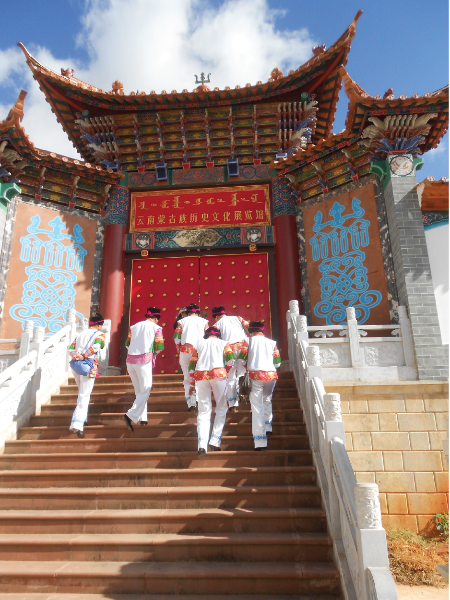
Khatso women wearing their traditional dress visiting Three Saints Temple, recently rebuilt, which houses statues of Genghis Khan, Mongke Khan and Kublai Khan—the three Mongolian emperors now venerated as ancestors. Nowadays, only women in their 60s and older wear traditional clothing on a daily basis.
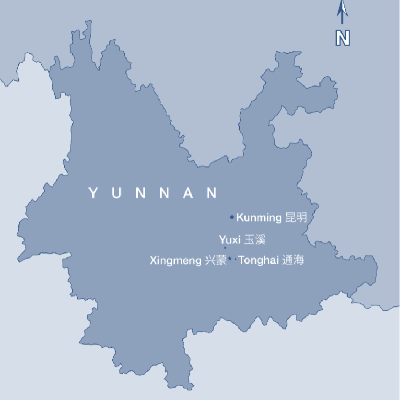
The Khatso 喀卓 live in a single farming village called Xingmeng 兴蒙, which is located in central Yunnan 云南 Province in China’s southwest corner. Located in Tonghai 通海 County, the village is only 15 kilometers west of the county seat Tonghai. Kunming 昆明, the provincial capital, is about 100 kilometers to the north.
 The Khatso descend from the Mongol troops Kublai Khan brought to the region in 1253
as part of his campaign to conquer China (Gao 2001; Huang 2009). At the time, Yunnan
was a separate kingdom ruled by an ethnic Bai dynasty and it contained a number of
distinct ethnic tribes such as the Ngwi (or Yi 彝), Hani and Bai (He 1989; Mu 2002).
The Mongols invaded with 100,000 soldiers and quickly conquered the region, stationing
troops in strategic spots around the province. Many of the soldiers married local
women and settled permanently. Given the linguistic history of Khatso, it seems likely
that many of these women spoke a variety (or varieties) of Ngwi, which is why the
modern language belongs to the Ngwi (or Yi) family. The Mongol-led Yuan Dynasty was
overthrown in central China in 1368, but Mongol forces held Yunnan until 1381. Once
they too were defeated, the surviving Mongols fled. A group from the military fort
in the mountains above modern-day Xingmeng, said to be the relatives of the last commander
and his troops, fled to the marshy western edge of Qilu 杞麓 Lake, which was much larger
then than it is today. They are considered to be the ancestors of the Khatso, and
their secluded destination is where modern Xingmeng sits today.
The Khatso descend from the Mongol troops Kublai Khan brought to the region in 1253
as part of his campaign to conquer China (Gao 2001; Huang 2009). At the time, Yunnan
was a separate kingdom ruled by an ethnic Bai dynasty and it contained a number of
distinct ethnic tribes such as the Ngwi (or Yi 彝), Hani and Bai (He 1989; Mu 2002).
The Mongols invaded with 100,000 soldiers and quickly conquered the region, stationing
troops in strategic spots around the province. Many of the soldiers married local
women and settled permanently. Given the linguistic history of Khatso, it seems likely
that many of these women spoke a variety (or varieties) of Ngwi, which is why the
modern language belongs to the Ngwi (or Yi) family. The Mongol-led Yuan Dynasty was
overthrown in central China in 1368, but Mongol forces held Yunnan until 1381. Once
they too were defeated, the surviving Mongols fled. A group from the military fort
in the mountains above modern-day Xingmeng, said to be the relatives of the last commander
and his troops, fled to the marshy western edge of Qilu 杞麓 Lake, which was much larger
then than it is today. They are considered to be the ancestors of the Khatso, and
their secluded destination is where modern Xingmeng sits today.
In order to survive in their new villages, the former soldiers fished as well as farmed
(Huang 2009). They escaped ongoing persecution by hiding in the marshes or rowing
boats out into the lake (Lin 1976). As a result, local historical records refer to
them simply as ‘the fishermen’ yufu 渔夫 and their original villages as the Three Fishing Villages sanyucun 三渔村. Their isolation led to the development of an independent Khatso language and
culture over time.
Like many other minority groups in China, the Khatso benefited enormously from the
agricultural, educational and political reforms of the past decades. Today, Xingmeng
is a relatively prosperous rural village. Khatso remains the everyday language of
the village, but widespread bilingualism, due to the education system and the dominance
of national Chinese media and culture, has made it an endangered language (Dai 2008).
Further Reading
Dai, Qingxia 戴庆夏. 2008. Yunnan mengguzu gazhuoren yuyan shiyong xianzhuang jiqi yanbian 云南蒙古族喀卓人语言使用现状及其演变 [Language use and its evolution among the Yunnan Mongolian Kazhuo people]. Biijing: Shangwu Yinshuguan.
Gao, Fayuan 高发元. 2001. Mengguzu: Tonghai Xingmengxiang 蒙古族 — 通海兴蒙乡[Mongolians: Tonghai Xingmengxiang]. Kunmíng: Yunnan Daxue Chubanshe.
He, Jiren 和即仁. 1989. Yunnan mengguzu yuyan jiqi xishu wenti 云南蒙古族语言及其系属问题 [Yunnan Mongolian and the classification question]. Minzu Yuwen 民族语文 [Minority Languages of China] 5.25-36.
Huang, Chun 黄淳. 2009. Mengguzu jianshi 蒙古族简史 [Concise history of Mongolians]. Kūnmíng: Yunnan Renmin Chubanshe.
Lin, Shezhi 林舍执. 1976. Lingcheng fenghuangde renmen – Yunnan mengguzu jianj1 凌乘凤凰的人们 一 云南蒙古族简记 [Approaching the phoenix – Brief notes on Yunnan Mongolians]. Yunnan mengguzu 云南蒙古族 [Yunnan Mongolians], 1-8. Hohhot: Inner Mongolia Teacher’s College.
Ma, Shiwen 马世雯. 2000. Mengguzu wenhuashi 蒙古族文化史 [Mongolian cultural history]. Kunmíng: Yunnan Renmin Chubanshe.